Tuesday, October 28, 2008

Sheer Fabrics


While the use of sheer fabrics in fashion is most definitely not a new thing, there was a recent article from the New York Times that made me think about nudity and the runway. Is it simply a matter of the context of the runway versus that of the everyday? It seems a bit ironic because in a way, models are supposedly the most good looking people and are therefore the most sexualized and coveted women, and yet when they walk the runway it's not sexual for them to wear sheer tops, or no tops at all? Is it a matter of small breasts vs larger ones?

I haven't quite made up my mind, but it brought to mind Adel Abdessemed's "Real Time," a thirty second video on a loop of a performance he made asking people from Craigslist to come to the gallery and have sex with each other while visitors watched. It's the same situation of context: sex in a gallery versus sex in a porn. Granted there is a more overt message of voyeurism in the artwork, but I think fashion is also voyeuristic in the way it makes makes it alright to see half nude women.

Saturday, October 11, 2008

Oral History


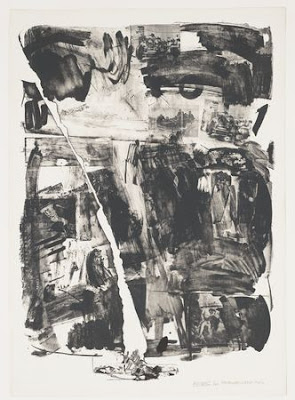
In my research about American printmaking during the 60s and 70s, there is one anecdote that is repeated many many times. It is the story of Robert Rauschenberg's famous lithograph "Accident" (1963) printed by Bob Blackburn at U.L.A.E. The literature says that in the middle of printing, the stone broke. Rauschenberg turned to Blackburn and said something to the effect of, "I like the effect of this broken stone, let's keep printing and see what happens." This event has been hailed by many scholars to show the experimental nature of Rauschenberg in many different mediums, and also that he did something unprecedented in the history of printmaking. As the printing continued the two stones moved farther and farther apart from each other so that no two prints are the same. (No two prints are ever the same anyway, but in this case the difference is more obvious.)

However, in a video from 1976 called "The Print World of Tatyana Grosman," Rauschenberg recounts the story differently. He said that the stone broke the first time, and he re-made the stone because he was unhappy that it broke. Then, it broke a second time. He said, "Once I can take, twice I can't...I said [to Blackburn] you broke it twice you print it that way...I won't let anything be wasted." This is very different from the idealized artist-as-innovator that the literature depicts. The way that Rauschenberg tells the story makes it seem as though he was very upset that the stone broke, and of course, blamed the printer who was simply doing his best to make the stone level as it went through the press. I find this interesting because I think it shows the relationship and attitude between artist and printer as one of the "creative genius" vs the artisan, the craftsman. Further, this discrepancy shows how things get mangled and changed over time.

What kills me a little is that as a child I would go to Bob Blackburn's Printmaking Workshop on Seventeenth Street with my father. I would sit at the side and work on a small plate while my father printed, and then we would go downstairs to have lunch at the tiny hole in the wall restaurant where they served rice with butter and french fries. I met Blackburn many times but he died before I became truly interested in printmaking.

Monday, September 1, 2008

Saturday, August 23, 2008

Leggings


Under normal circumstances, I hate everything about leggings. The fact that they don't cover your feet. Those horrible awkward length ones that hit mid calf. The way that most people wear them as a substitute for pants. The fact that it has forced me to see the horribly shaped asses and legs of strangers. However, there are a few people that wear leggings well. Most noticeably for me, M.I.A. (look here! amazing!) Her style has made me highly intrigued by leggings with patterns on them, and not the ridiculous American Apparel "Afrika" patterned leggings (which is mildly offensive and a very unoriginal ripoff of this past seasons "ethnic" obsession), but rather these just4fun. I'm picturing them paired with other insane patterned clothing, short skirts, or the classic all black contrast. This one is my favorite:


I think the following people pull off the leggings situation really well. I think it has to do with the proportions created. It's never tight top + leggings, it usually looser longer tops + leggings or looser tops + short skirts or shorts + leggings that make it look good.

From Face Hunter:


From style bubble:

Friday, August 22, 2008

Jesus in the Sand

My friend S. made this sand man with his girlfriend. I think it looks like Jesus.


Saturday, July 26, 2008

Easy Rider


I have always wanted to go on a trip across America. Easy Rider simultaneously made me want to do it more because of the beautiful landscape and cowboy aspect of being on the road alone, but also made me want to do it less, for obvious reasons if you've seen the movie. Someone I was talking to recently said he remembered the movie feeling dated, and I was thinking about that aspect last night. I think it's dated in the sense that the characters go to a hippie commune, and also in some of the language used (there are two moments in the film where this is evident: one character asking what L.A. is, and the other one asking what 'dude' means. He defines 'dude' as 'a regular guy'). Further, I think the film captures what it was like in 1969, the transitional period when Pop art already happened, rock and roll already happened, the summer of love was over, and drug usage was shifting from weed towards harder drugs and was becoming more of a business venture. There are moments in the film where you recognize a general sadness, a desperation, that occurs when people are disillusioned, both with the end of the 60s but also in a way with the cowboy ideal. They are like modern cowboys. Cowboys who do drugs. The bikes act as their companions like horses, the open roads, the enemies, the tense diner scene which parallel the tense saloon scenes in most cowboy movies (except here the cowboys leave instead of fighting), and the solitude of the landscape. Cowboys embody a certain American prototype ideal, but in Easy Rider it's almost as though that ideal has become jaded just like some of the later cowboy movies that were made and just like they became jaded with the sixties. Aside from that, I think the movie is still surprisingly relevant today, especially in terms of the hatred that is expressed, which is something I tend to forget because I live in NYC. That, and just how huge America is.

Also, on the about the movie part of the DVD they said that there is no time in the film where you see someone smoking weed and they are not actually smoking weed.

These were stolen from the internet:


Now I want to see more motorcycle movies!

Sunday, April 20, 2008

An Outfit


Shirt: Barneys Co-op
Jacket: DKNY
Skirt: American Apparel (cut)
Boots: Frye
Cuff links, tie, and tights: Mother's closet

This outfit was inspired by a trend that I noticed: men's suit jackets. I particularly like the over sized exaggerated jackets out of less structured materials. I was reading an interview in i-D with the Comme des Garcons designer Junya Watanabe about his menswear line, and the author mentioned in passing that Ann Hollander said the reason why menswear "does not move on from the suit, because the suit is the most perfect garment ever created for either men or women." Interesting.